When I started sharing my off-grid journey, I never expected it to become quite so emotional or controversial. Right now, though, things feel like they’ve come to a standstill. I’ve done what I can, followed the processes, asked the questions, and pushed where it made sense to push. For the moment, all that’s left is to wait and see what the next move from City Power and the City of Johannesburg will be.
And yes – it’s disheartening. But before I step back from this chapter, I want to leave one thing very clear.
Despite all the frustration, anger, and distrust around registration, meters, and levies, there is a legitimate engineering and safety reason why registering off-grid and solar systems matters. And it’s not the one most people think.
This isn’t only about fees
There’s a widespread and understandable perception that registration is being used by municipalities to recover lost revenue after years of under-collection and mismanagement. That reality can’t be ignored.
The real issue, though, is that any legitimate engineering and safety rationale has not been clearly or transparently communicated. Instead, consumers are met with vague messaging, implied penalties, and poorly explained costs – which has fuelled mistrust and backlash.
That’s a pity, because at its core, registration should be about something far more constructive: proper monitoring of the grid and ensuring safety for everyone involved.
Why monitoring matters
Even if you have solar and batteries and consider yourself “off grid”, the reality is this:
Most of us are still connected to the grid.
That means electricity can flow both ways – from the grid to your home, and in some cases, from your system back into the grid.
If electricity flowing into the grid from private systems is unregulated or unknown, it can cause real problems. Power networks rely on very stable conditions – especially frequency and load balance. When unmonitored systems feed energy back into the grid, even unintentionally, they can disrupt that balance. Enough disruption, and the grid can trip or shut down to protect itself.
That’s not a revenue issue – that’s a stability issue.
The safety reality we don’t talk about enough
There’s another side to this that matters even more: people’s lives.
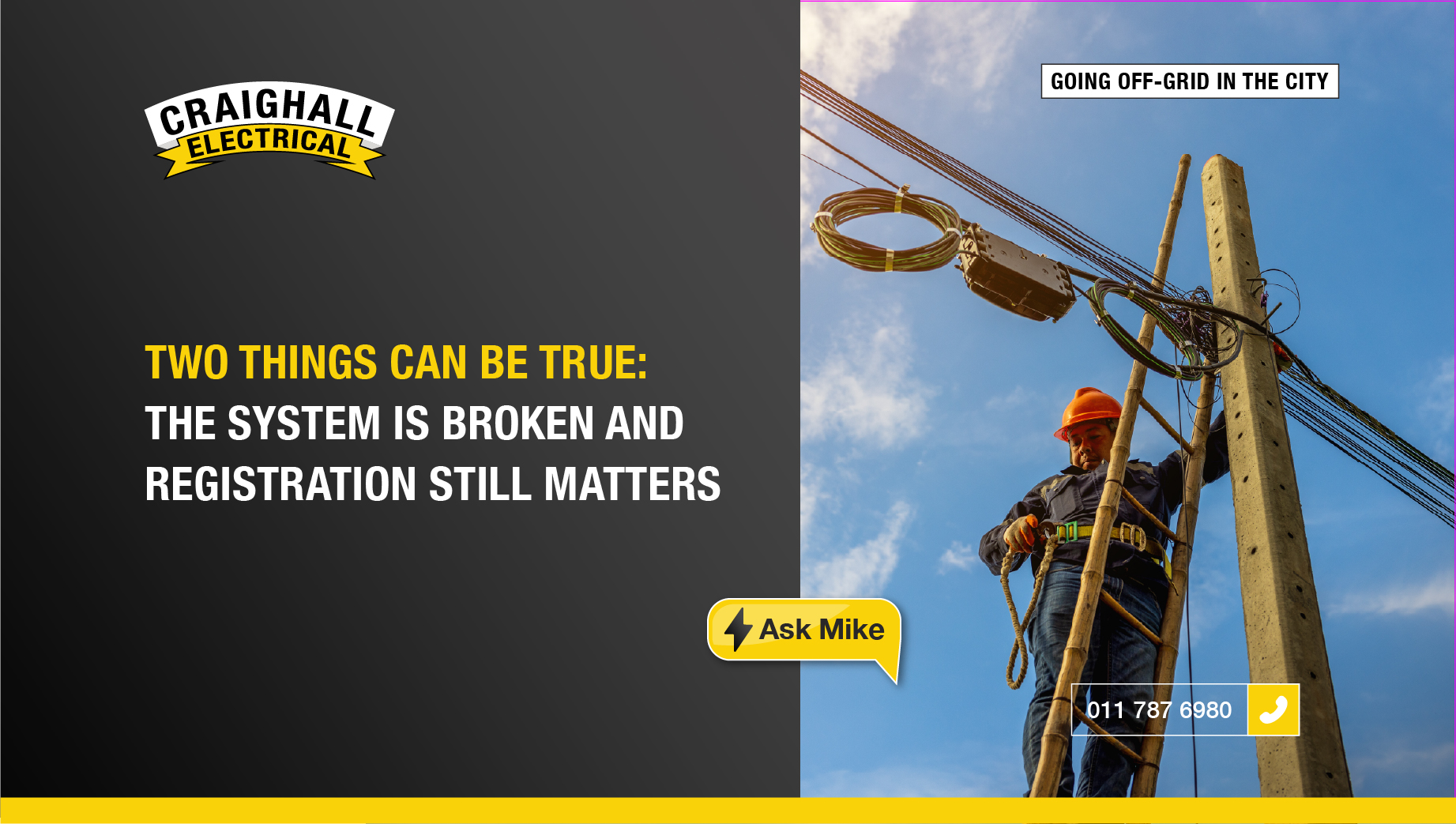
Utility providers have a legal and moral responsibility to protect their line workers. When a team is sent out to repair or maintain a power line, they need absolute certainty that the line is dead.
If there’s no visibility of who is generating power and where, a supposedly “dead” line could still be live because electricity is feeding back from a private solar system. That’s incredibly dangerous.
The proper solution here isn’t vague penalties or threats – it’s the right equipment.
What should be in place is a directional (or bi-directional) meter with built-in safety protection. This type of system ensures that when power needs to be cut for maintenance, any export back into the grid is automatically blocked or isolated. That way, workers are protected, and homeowners can still generate safely for their own consumption without exporting to Gridd.
That’s a levy I would support.
That’s a system worth paying for.
Fees need purpose and transparency
I’ve said this before and I’ll say it again:
I’m not against fees or levies if they exist for the right reasons.
If costs are clearly explained, linked directly to infrastructure protection, grid stability, and human safety – most reasonable people will understand and engage.
What leaves a sour taste is when fees appear without clarity, communication, or context. When costs feel implied, threatening, or disconnected from real outcomes, trust disappears very quickly.
We’re still part of the system
Solar homeowners need to understand something important too:
Going solar doesn’t remove us from the grid ecosystem, (unless you opt to remove the connection and go off -Grid)
Whether we like it or not, we’re still connected and what we do affects others. That’s why monitoring matters. That’s why proper systems matter.
The frustration is that municipalities often focus on enforcement before education, penalties before explanation, and control before collaboration. That’s where this whole process starts to unravel.
A word of thanks
I do want to say this: throughout my engagement with the City of Johannesburg, the people I’ve dealt with have been kind, helpful, and genuinely willing to assist. That humanity – often overlooked – is what has kept me in the game when I’ve wanted to walk away.
Systems may be broken, but the individuals inside them are trying.
Where things stand – for now
So, this is where my off-grid journey pauses. Not because the questions are answered, but because there’s nothing more I can actively do right now – and I am also waiting to understand the financial impact of going off-grid and disconnecting with the post-paid conversion that local municipalities are imposing.
Like many of you, I’ll be watching to see what changes – if communication improves, if processes become clearer, and if the focus shifts toward the things that really matter: safety, stability, and fairness.
I’m not convinced things will change quickly. But I still hope they will.
This may be the end of this chapter, but I’ll continue to engage on all things power and solar – asking questions, sharing insights, and trying to bring clarity where I can.
If you’ve had your own experience, or if you have questions, I’d genuinely love to hear from you askmike@craighallelectrical.co.za